In this personal blog, I give my reaction to the commemorations of the Dromcollogher fire disaster of 1926. From my first job opening of the memorial garden financed by the Mayoral Fund, to laying a wreath at the grave and then being honoured to give the opening address at the State commemoration, it was such a moving day. But mostly it was about the people - those I met, those we remembered and those who were instrumental in making the day happen
There are occasions when public projects begin with a plan, a budget or a drawing.
This one began with stories – both sad and brave stories.
Councillor Jerome Scanlon first encouraged me to meet the Dromcollogher ’26 Committee and hear about its plans for the centenary. Jerome always made himself available throughout the process, helping me to ensure that my contribution would be meaningful and lasting. He and the committee members helped me understand the scale of what happened and the importance of commemorating it properly.
That first meeting had a profound effect on me.

On 5 September 1926, 48 men, women and children lost their lives when fire swept through an impromptu cinema in Dromcollogher. In a town of approximately 500 people, almost one person in every ten was lost.
But statistics can flatten what history should sharpen. The committee brought alive the people behind the number: the children, the families and the lives cut short. They spoke too about the survivors and the silence that followed.
Later, at the committee’s fundraiser at the Limerick dog track, I witnessed first hand the extraordinary commitment of the wider community. It was clear that people wanted this centenary to be marked with dignity and ambition.
I could simply have made a donation. But I felt strongly that support from the the Mayoral Fund should create something meaningful – something that would endure long after the official ceremonies were over.
The space between two gable ends
At a meeting at the Dromcollogher Library, we looked at the space between the two gable ends in front of the building. I suggested that it might become a new public garden.
The committee already had plans for a memorial walkway and understandably did not want a new idea to that that at risk. I assured them that their priority would be protected by me if the hoped-for fundingdid not materialise and asked that we also explore what the library space might become.
We had recently completed a public realm space in Askeaton, and I encouraged the committee to visit it—not to copy it, but to see what ideas it might inspire for the somewhat dated and enclosed space in front of the library.
From those conversations emerged the idea of removing the high railings and opening the space to Church Street. Then came the concept of an outdoor cinema: eight benches facing a whitewashed screen, creating a quiet echo of the improvised picture house that once stood here.
I initially worried that this idea might trigger upset—whether returning a cinema to the site of such suffering could reopen, rather than help to heal, an old wound.
But the committee agreed the idea was work exploring. With inspiring ideas from Manuel Smalis of LCCC and funding obstacles overcome, the excitement grew.
I can still remember the design meeting in my office as the concept took shape: the railings coming down, a screen on one gable and a stone pillar doubling as a lectern while preserving access to the library. Today, it was a real pleasure to see those ideas coming into being.
Brass plates along the benches carry the names and ages of the 48 victims. Anyone who sits there—today, or decades from now—will sit with them, by name. I saw first hand the power of that idea as I guided one returning relative along the benches to find her family members’ names.
The stone lectern can now serve a teacher reading to children or hold a projector. Helped by an external electrical connection. Later tonight, as darkness falls, it will host a slide show of images from a century ago.
As sunshine filled the garden and Church Street this morning, I could find myself imagining children emerging from the library with books, sitting on those benches, listening to a story or watching a film: a place of unimaginable loss becoming part of another generation’s everyday happiness.

That does not diminish what happened there. It gives memory somewhere to live.
Shaped by fire
The sculpture created by Eric O’Neill and Naomi O’Nolan overlooks the garden now from the other gable, giving artistic form to that same idea.
It is a work forged in fire—metal shaped by the very element that took so much from this place, now made into something enduring and uplifting. It will form part of the Mayoral Art Collection, but it will remain in Dromcollogher, where it belongs.
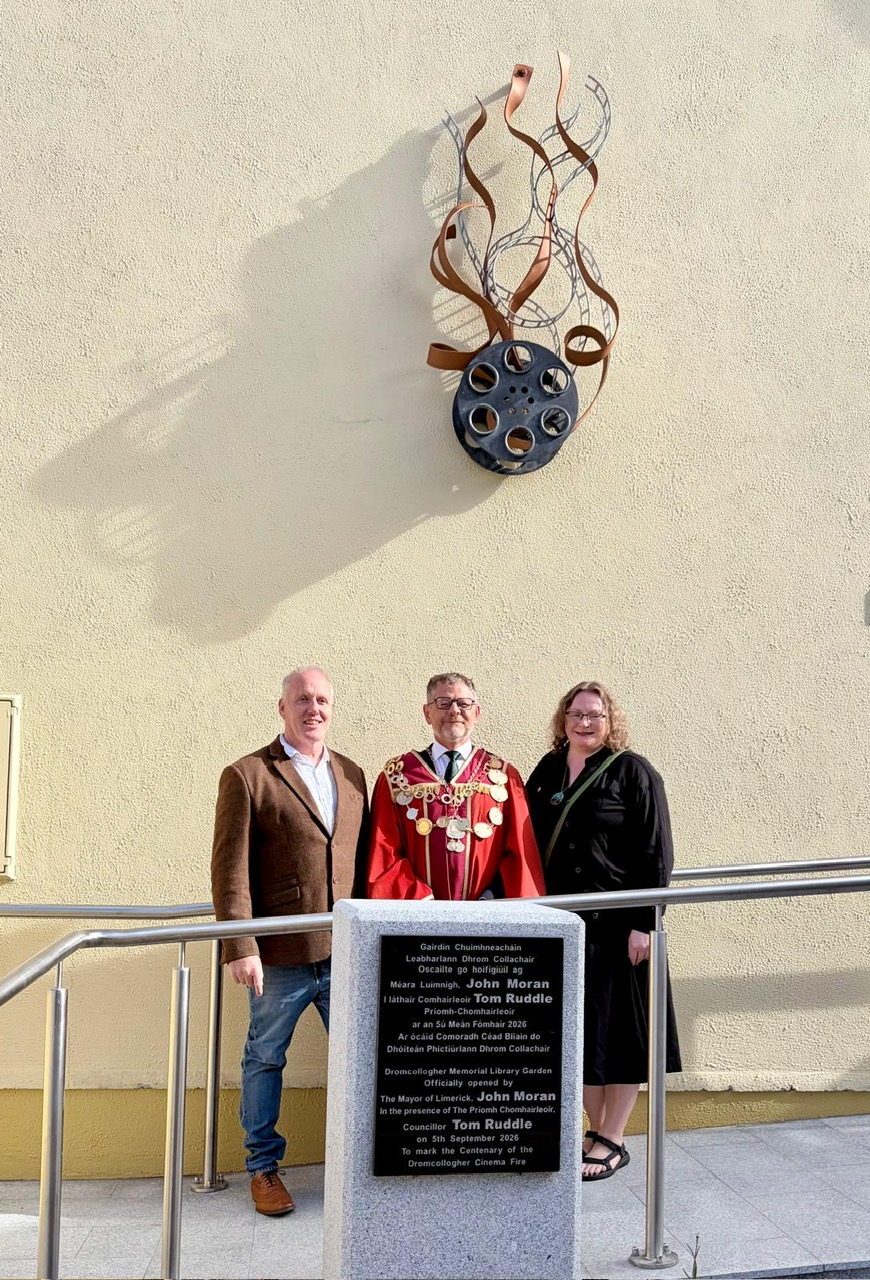
Inside the historical display is deeply affecting. Its old newspaper reports could hold a visitor for hours. I was delighted that the newly renovated library’s beautiful circular design remains, drawing you from the history of the Burning to the bookshelves and the continuing life of the building.
Walking with memory
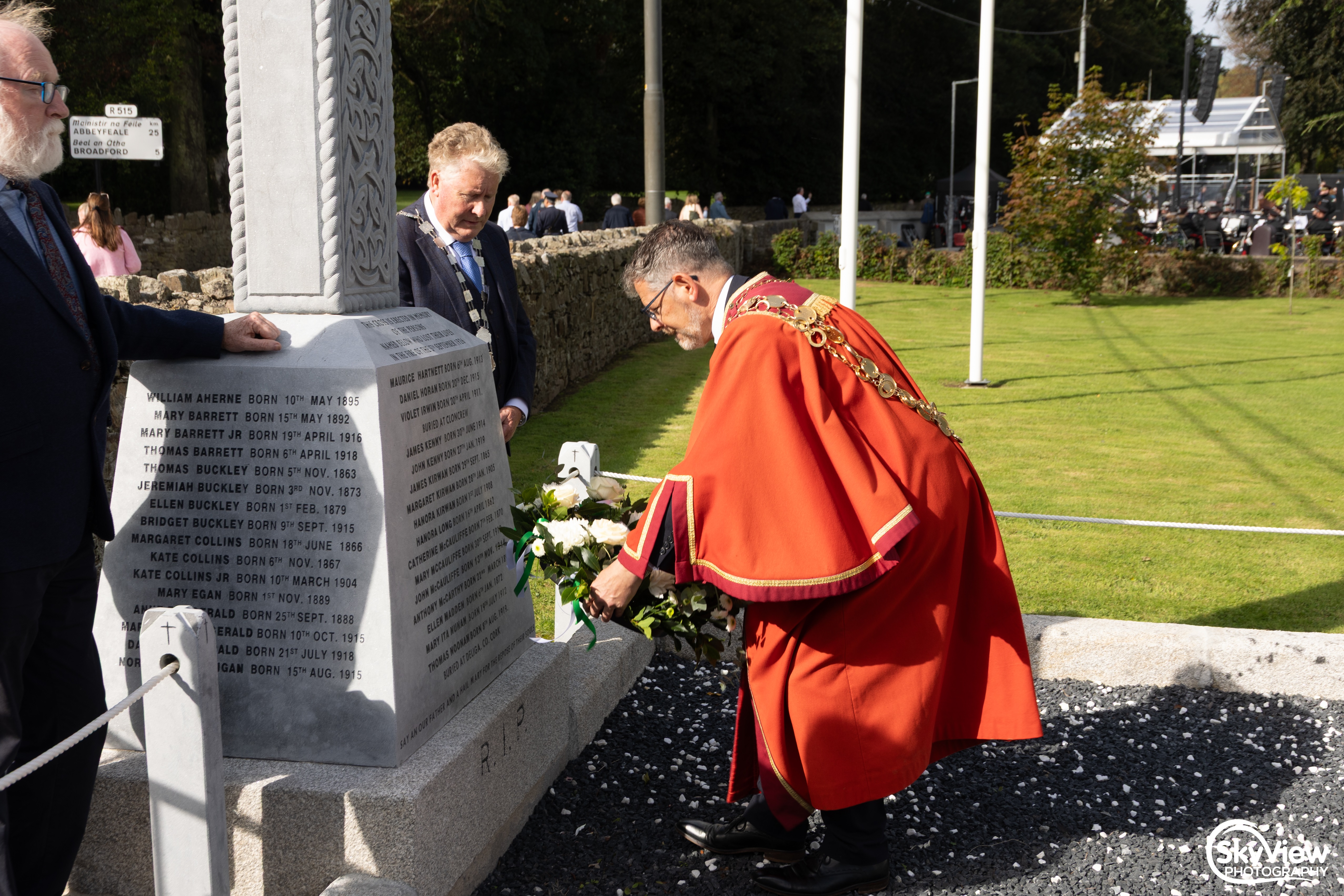
Before the formal State ceremony, walked from the library to St Bartholomew’s Church with Priomh Comhairleoir Tom Ruddle and Councillors Jerome Scanlon and Brigid Teefy.
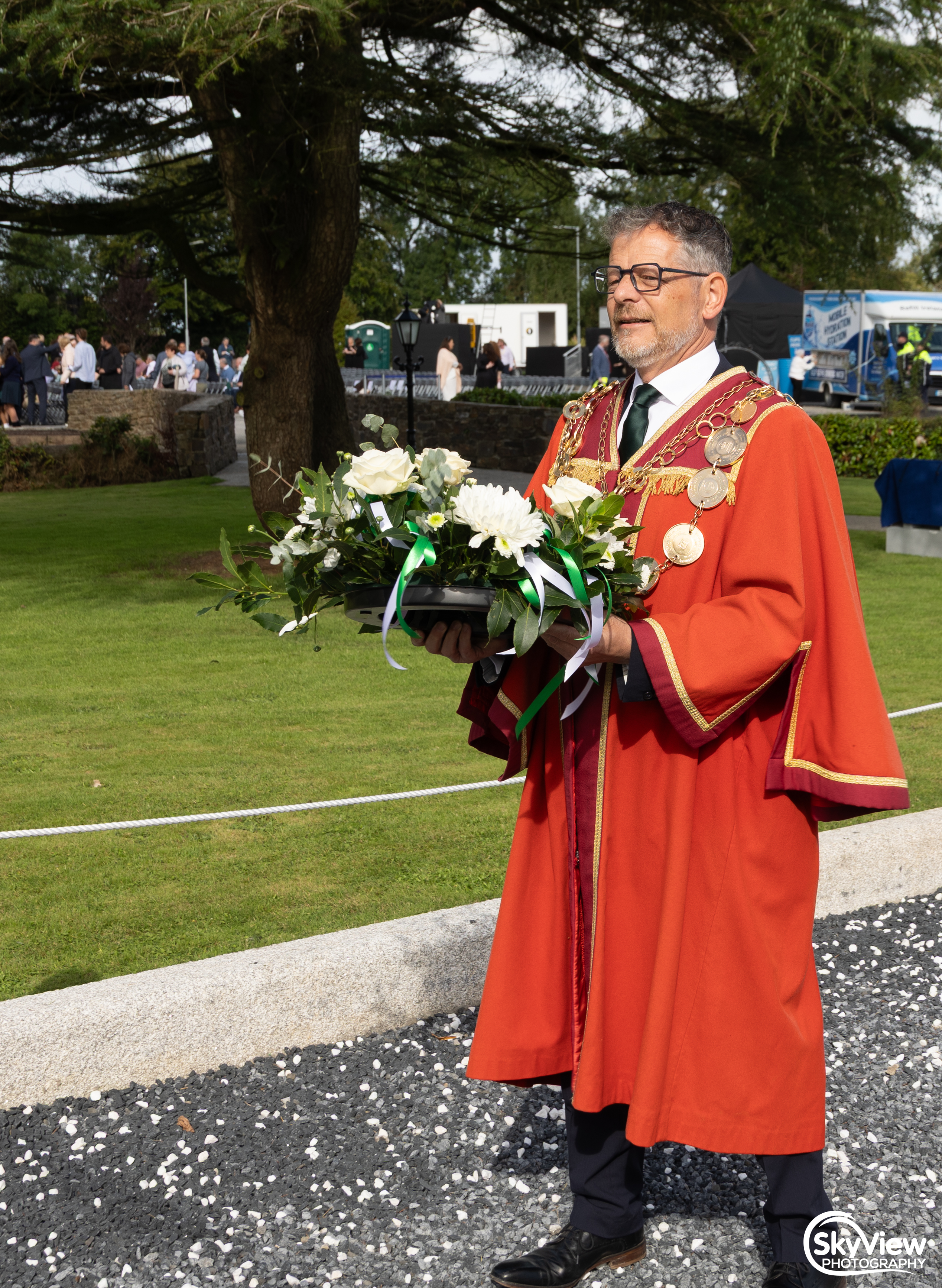
Together, we laid a wreath at the communal grave on behalf of all the people of Limerick. I felt that this was important to do. A simple but important acknowledgement, in the colours of Limerick at the base of the stone cross bearing the names of victims. Later as families passed by after the ceremony, I felt proud that they could see this expression of Limericks solidarity.
A Fitting Commemoration
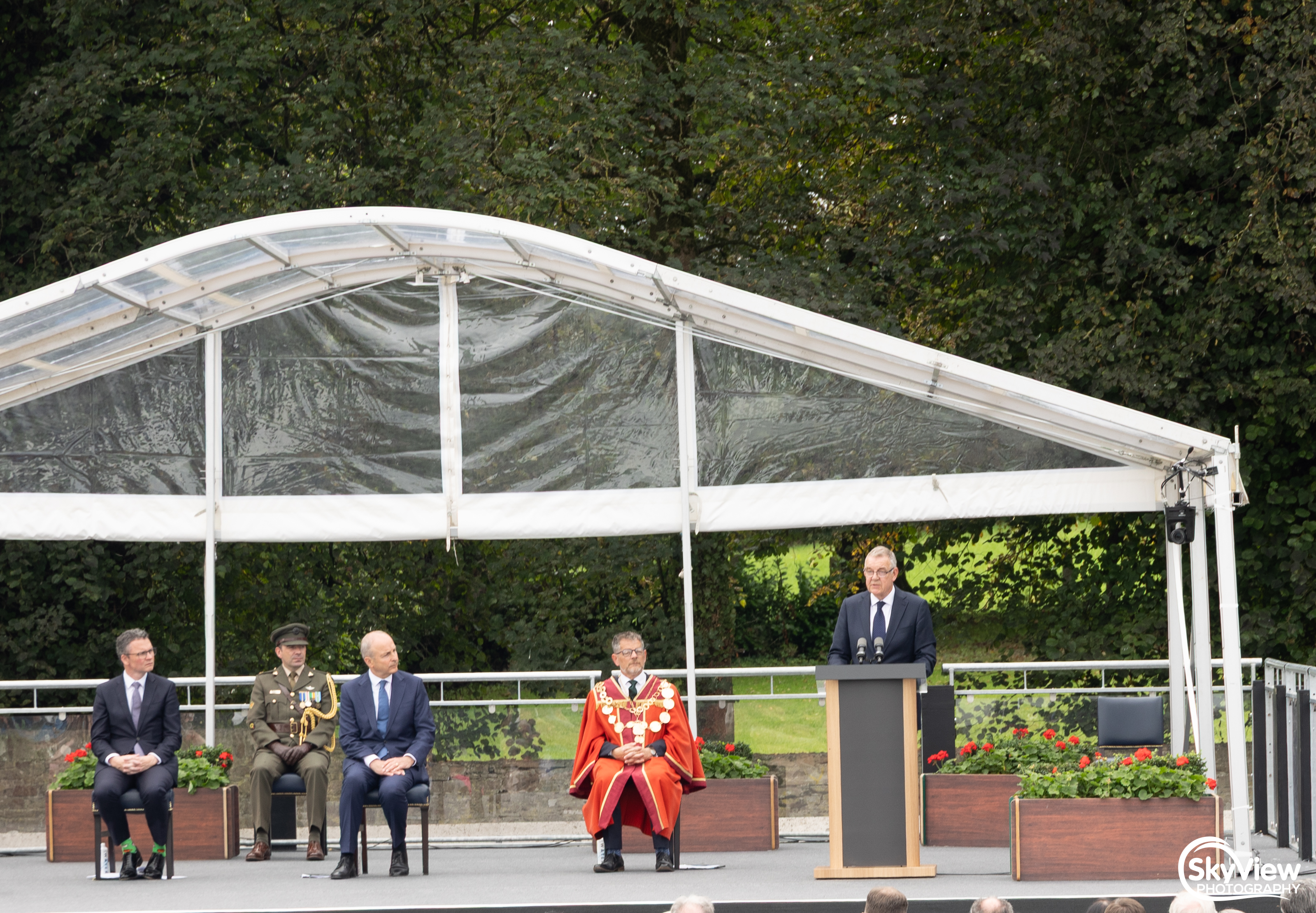
During my short address at the ceremony, I noted that for decades much “remained unspoken, from grandparent to grandchild and neighbour to neighbour.
That silence was not forgetting. It was a way of surviving.”
But that now “that reticence changed because people in Dromcollogher themselves decided that the story should be explored and expressed in new ways.
Fittingly from a disaster born out of new artistic format, the cinema, it was artistic expression that played perhaps the greatest role in the day’s healing – the new sculpture, the specifically commemorated piece of music sung by the local choir and the rendition by two young adults, of thoughtfully selected poems.
After the speeches, relatives and descendants told me about people who stayed behind trying to save others; of those who did not make it and of survivors who carried lifelong guilt because friends and family had not escaped like they did.
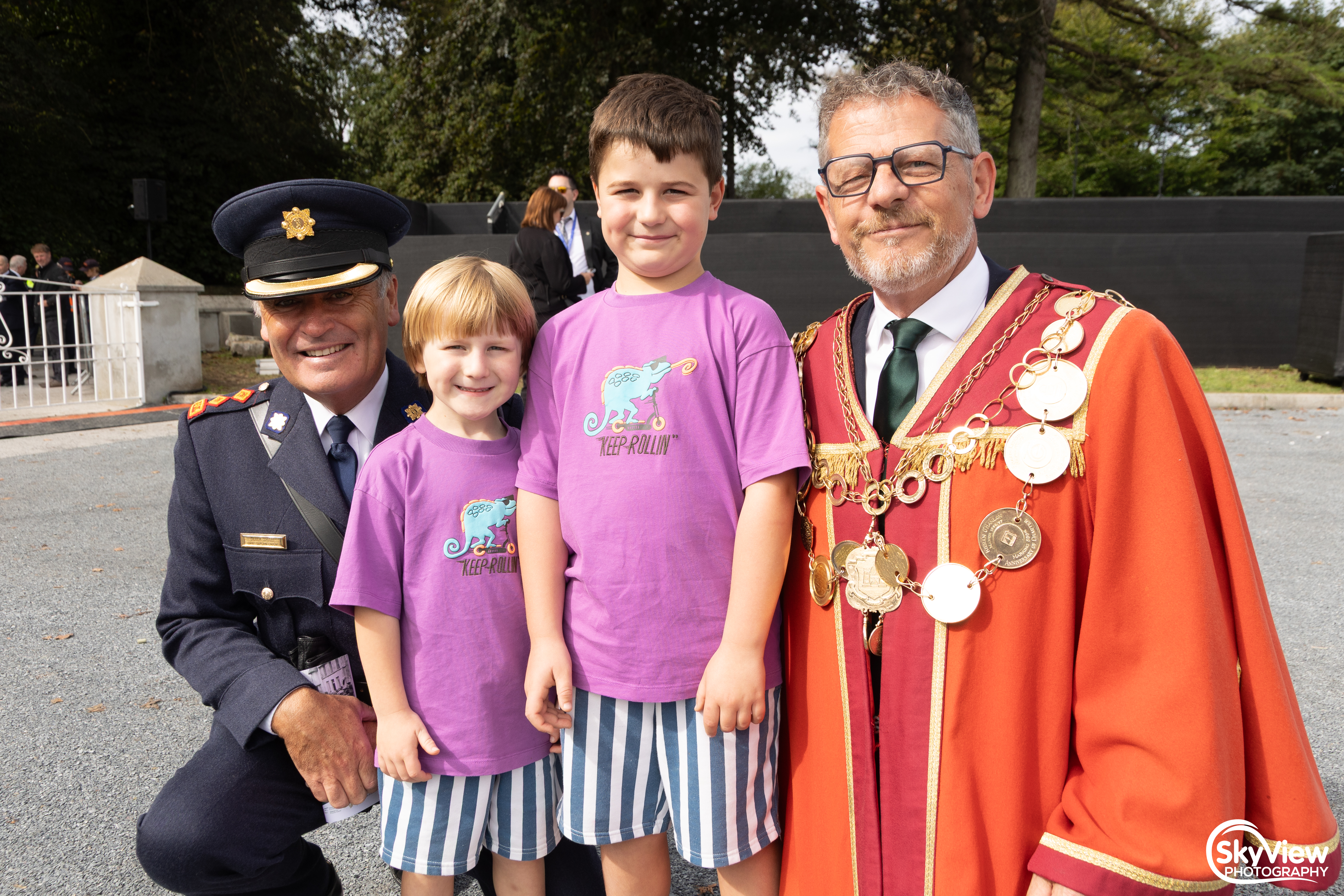
I sensed through the day how much it meant to families to be present today and to tell storiesthat earlier generations had found almost impossible to share.
The Taoiseach captured something else essential in his own address when he said that the disaster reminds us of “the fragility and preciousness of life”.
Before leaving Dromcollogher, Damien and I went to see the newly decorated St Bartholomew’s Church and left a small note of remembrance and prayer.
As we drove away, I felt mixed emotions: profound sadness for the lives lost and the suffering carried across generations, but immense admiration for a community that found the courage to bring what had remained unspoken into the light.
One hundred years ago, this was a place devastated by tragedy.
Today, that same place stood together and sang.
It was a reminder of what a community can endure— and to what even after the darkest of nights, it can still become.
More than anything, the day in Dromcollogher left me with one stark enduring truth. Like is fragile, every moment is precious and none of us should ever take either for granted.
Read my remarks at the opening of the Centenary Memorial Garden at this link. https://assets.nationbuilder.com/limerick/pages/1415/attachments/original/1789338406/Dromcollogher_Centenary_Main_Ceremony_Speech_-_Final.docx?1789338406
Read my full address to the State Commemoration at this link. https://assets.nationbuilder.com/limerick/pages/1415/attachments/original/1789338406/Dromcollogher_Centenary_Main_Ceremony_Speech_-_Final.docx?1789338406