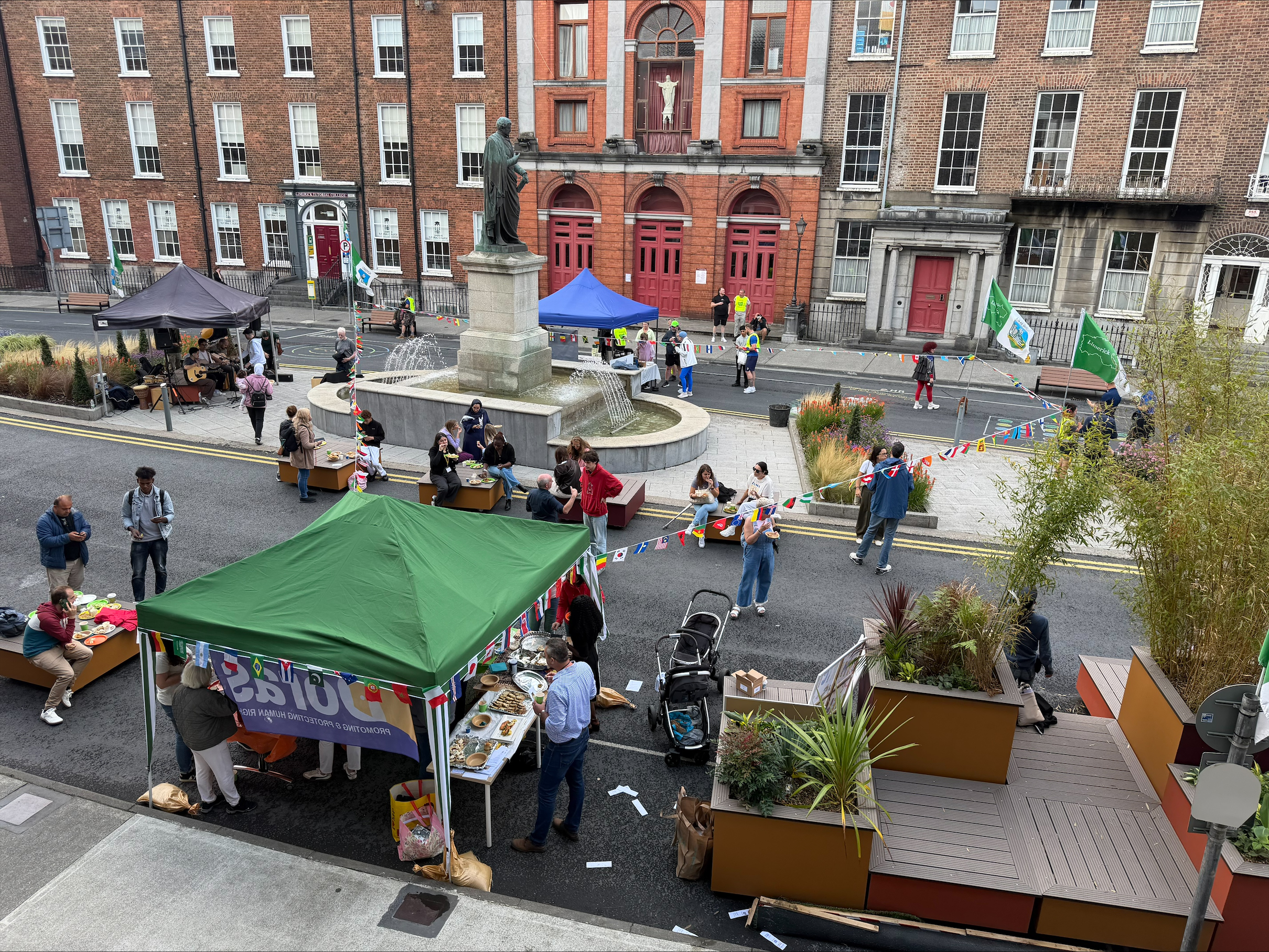
In this post, I give my reflections on my Summer In The City initiative in Limerick and how the people of Limerick seem to have rediscovered their city and like what they are seeing. An initiative designed to animate new public spaces opened up to the public to test concepts for our new proposed public realm and mobility plan, it became much more.
Over recent weeks, I have seen Limerick coming alive again.
Summer in the City became more than the activation of public spaces. It became a visible sign that Limerick’s appetite for change is very real.
It was intended as a series of trials. Now that they are over, the discussions must continue. The ongoing public consultation on my proposals for new public-realm and mobility plans gives the perfect opportunity for that. We can ask which elements should return next year, which can be improved and which might eventually become permanent features of Limerick’s streetscape.
What seemed unimaginable to many even as recently as July became a reality in August. Children played on an urban beach beside the Shannon. People sat on benches reading books and drinking coffee on Glentworth Street. Salsa dancers, swing dancers, set dancers and musicians brought streets to life. Families gathered to try unfamiliar traditional sports or enjoy the amusements at Arthur’s Quay. Publicans and traders created new energy on Nicholas Street and Back Lane. The Crescent went back to its historic role as a meeting point for the community—a magnificent sun-drenched place to relax beside its restored fountain under unparalleled Georgian architecture, hosting sport, music, children at play and one of the liveliest céilís imaginable.
The sun undoubtedly helped. But this was about much more than sunshine.
What we witnessed was a city being rediscovered by the people – young families coming out to enjoy the city streets and older residents overcoming hesitancies and discovering they too can enjoy a new safe feeling in the city centre even into the evening.
The energy, creativity and appetite for something different were already here. What was needed was an invitation—and public spaces in which that energy could emerge.
Nothing captured the spirit of the month better than when Limerick stalwart Cha Haran and his friends—some of them over 80 years of age—came together to perform free concerts for hundreds of well-wishers and old fans. They ended their second performance with the Lovin’ Spoonful’s “Summer in the City”, an homage to the month we had shared, before paying their own tribute to Dolly Parton.
Different Places, Different Possibilities
We too often think of streets only in terms of movement: how quickly can traffic pass through them, where can cars be parked or how can people get from one destination to another.
Those considerations matter. But successful blocks and streets are also places to meet, trade, perform, rest, dance, play and belong.
Summer in the City was a series of experiments in how people might use familiar spaces differently and to see if it might nudge them back to use the city centre more. Each location developed its own personality.
The urban beach was perhaps the greatest revelation.

Many people discovered a part of their city that they had rarely visited. A largely abandoned space became an urban beach beside the river: somewhere parents and grandparents could make memories with children, friends could sit together, and anyone could watch the Shannon pass by.
It worked throughout the day without always needing organised entertainment because the place itself worked. People could pause and enjoy their city without being required to spend money. And it worked in the evenings too.
The positive impact on nearby businesses, especially the French Table, belied claims everything was going to be negative for traders. The beach also revealed the synergy with the adjoining skatepark as an evening destination. Young people, diners, families and visitors began to inhabit the riverside differently.
That response has given me the courage to consider how we can invest further in this long-neglected part of the city and a confidence that like me the people of Limerick know we need to try new things and are willing to do so.
Glentworth Street Lower was a different experiment. A largely underused street, with the enthusiastic support of three local businesses, developed the feel of a temporary city garden. People sat outside with coffee or read books. But its most memorable moments came when the street began to move—during evenings of salsa dancing, swing music and dancing beneath the open sky.
Nicholas Street and Back Lane evolved differently again. There publicans and businesses fostered much of the activation, creating new energy in historic streets and showing what can happen when those already rooted in a neighbourhood are given room to experiment even more.
Arthur’s Quay showed that traditional paid amusements still have a role. The funfair added colour and excitement to a large public space, complementing the many free events elsewhere. Not every successful public space must look or operate in the same way.
Limerick Ready to Welcome the World
As we look back at the month, we can see that Summer in the City became much larger than the programme we originally planned.
Limerick hosted a remarkable series of international sporting and cultural events during August. We invited participants into the city centre to showcase what was happening at the Obstacle Course Racing World Championships at Limerick Racecourse and the WFDF 2026 World Ultimate Club Championships at the University of Limerick.
Other organisations embraced newly animated spaces for their own events. The All Ireland Skateboarding Championship and the European Sport for All Games showed how streets and squares can become arenas for talent, movement and international friendship.
Some events received support from the Mayoral Fund. Others simply used the city as families and friends did throughout the month: as a place to gather, participate and have fun.
Dolans’ wonderful Docklands Festival deserves a special mention. Over several evenings, it brought thousands of people together to listen, dance and party beside the Shannon.
Together, these events demonstrated Limerick’s ability to welcome visitors from across Ireland and the world while retaining the particular warmth and personality that make our city special.
Learning as We Went Along
Given public commentary, I knew that the Crescent would be the most challenging and in many ways bravest—and one of the most important—of our experiments.
I will be candid: the first week did not work as I had hoped.
I underestimated the negative impact of moving the beach from the Crescent, where it had helped generate activity successfully in 2024. This year, events were spread across several locations. That was purposeful as great cities do not just have one meeting point. Our plan was designed to allow different communities across the city to participate in varied spaces, but it meant that the energy was less concentrated.
At the Crescent, initially too, the fountain was not operating properly. There was insufficient seating. We struggled especially at the outset to find the best way to tell people what was coming next or help them understand and imagine how the space could be used. Over and over again people were pointing out to me or on social media that they would have enjoyed going to an event but that they had not known it was happening until they saw the photos afterwards.
We learned and adjusted and we saw change happen before our eyes.
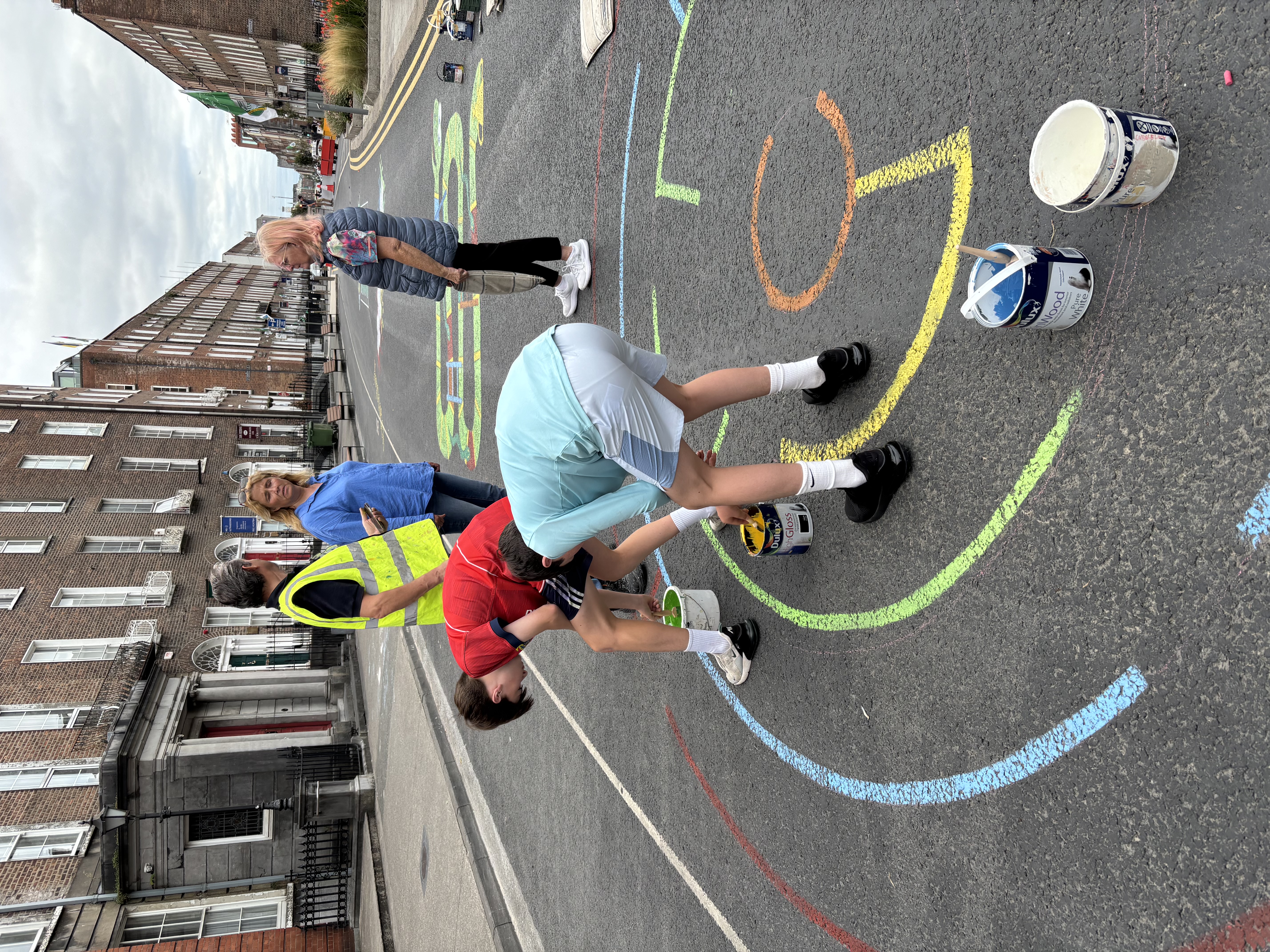
Once the fountain was repaired and more seating appeared, the Crescent began to come together. With each event, the crowds grew—not just in number but in diversity. Children played on street designs painted by local volunteers: hopscotch, Twister, snakes and ladders and a maze. “Sets in the City” brought music, dancing and a wonderful céilí atmosphere into the heart of Georgian Limerick. Local dentists closed early to give residents a traditional music performance. Business groups organised networking events in the pedestrianised spaces, demonstrating that opinion within Limerick’s business community was more varied than the July protest had suggested. On the final weekend, scores of children—perhaps more than a hundred—took to the tarmac with chalk and the local community and others came together for a long table shared dinner – a vista we admire in towns all over continental Europe during the summer.
There is much more we could have done with additional seating, planting, programming and improved communication. Even so, posts showing people dancing on the Crescent’s tarmac streets have attracted more than 170,000 views.
Generations have known the Crescent primarily as a traffic route. Asking people to re-imagine it as a majestic Georgian plaza—a civic space worthy of our city—will take more than a few summer weekends.
As the month went on understanding of the value of the plan grew and grew. People watched children play where cars normally pass. They danced in front of the fountain and experienced the Crescent as a place to stay rather than somewhere to drive through. Now that cars are back, children will likely ask to get back to the fountain to repeat fun games and not understand why cars have become a new obstacle.
These experiences cannot now be unseen.
I want to be honest and will admit too that not every location reached its potential. St John’s Square is a beautiful civic space close to communities whose residents may not have felt as involved in some of the other activities. Next year, we must engage earlier and better with those communities, residents and businesses to create a programme that genuinely belongs to that neighbourhood.
The purpose of a trial is not to declare every element a success. It is to discover what works, what does not and how we can do better.
What People and Businesses Told Me
Throughout these weeks, people repeatedly stopped me in the streets. They sent emails too. They told me to keep going. More than a few put it in particularly Limerick terms: “Feck the begrudgers.” It was not so much animosity towards the objectors as an unmistakable hunger for change—and encouragement when I needed it. People had unexpected fun and they want more.
That is not a scientific survey. But it is impossible to ignore the warmth of those encounters.
At City Hall, we watched carefully and recorded traffic movements. Schools returned during the final week without the predicted traffic chaos. Adjustments to traffic lights could certainly help, but there was no traffic disaster. Those who observed the result fairly could see that.
Many more spoke instead about the atmosphere, the enjoyment of their children and grandchildren, and the pleasure of seeing people from every background sharing the city together.
I also heard privately encouraging reports from businesses, including some that had concerns before the programme began. Since then some businesses have begun to share their positive results in public to reinforce the value of the trials.

Individual examples do not settle the wider question. We must now gather the evidence properly: footfall, business experience, attendance, traffic, accessibility, costs and feedback from residents and visitors.
We will retain what worked, improve what did not and learn from the entire experience.
A Full City Is a Safer City
The presence and support of An Garda Síochána throughout the month was welcome and must be acknowledged.
But one of the striking features of Summer in the City was how naturally free of anti-social behaviour its spaces felt when they were filled with people.
Families, friends, visitors and sometimes strangers danced, talked and enjoyed themselves together. Children occupied spaces normally dominated by traffic. Older people sat and watched the activity around them.
People create security through their presence. Activity brings confidence, passive supervision and a sense that a place belongs to everyone.
The atmosphere was not one of different groups keeping apart. It was one of people enjoying Limerick together.

None of this happened by itself. Long before most of us arrived each morning, members of the Council’s cleansing team were preparing the streets. Performers rehearsed, businesses made preparations and Council employees solved countless practical problems. Gardaí, emergency services, volunteers, sporting organisations and community groups all played their part.
Reimagining public space may begin with an idea, but it depends on people doing practical work every day. I am grateful to everyone who helped.
Why I Sought This Office
This summer has reminded me powerfully why I sought the honour of becoming Limerick’s first directly elected Mayor.
Damien and I deliberately arranged our summer so that we would remain in Limerick for August. I wanted to be here throughout the month—to support the teams, experience the programme on the ground, speak directly to those taking part, understand what was working and what needed to change and, in truth, enjoy the wide range of activities for myself.
Even during our scheduled break away in late July, however, I found myself working throughout—not only responding to the political attack, but stepping in because the initiative was not getting off the ground as successfully as we knew it needed to. I want to especially thank those colleagues and others outside City Hall who stepped in to help when I returned. Their work mattered. But I will be honest: the effort by a minority to scupper the entire programme before it began was disheartening for a while until I was able to see more clearly the wider support for the plans.
The attempted use of Section 140 would, if successful, have stopped all the road closures and prevented the public from experiencing the programme and judging it for themselves.
I was also deeply disappointed and, at times, taken aback by some of the personally abusive comments directed at me and at supporters of Summer in the City on social media. Some descended into explicitly homophobic abuse. Others sought to dismiss those attending events as “elitists” or not “ordinary” (whatever that is supposed to mean), even as families, children, older people and people from communities all across Limerick made those spaces their own. Debate, disagreement and scrutiny are essential parts of public life. Personal abuse—and contempt for people simply because they say that they are enjoying and welcome something new—should have no part in our Limerick.
But I do not come to the end of August discouraged.
I come out of it energised by what I saw.
Many of those moments happened without any awareness of the watching Mayor or a photographer. They were not performances for social media. They were genuine moments of happiness and connection.
Seeing them has renewed my faith that the people of Limerick share my vision of a more fun, inclusive, welcoming and confident place.
It recharged my batteries in a way that our deliberately short holiday—and certainly the work that intruded upon it—could never have done.
The Limerick revealed to me over these past few weeks is far removed from the failing picture presented by some of those who opposed the new ideas.
And now what next?
We must now use the opportunity of the consultation on the public-realm and mobility plans to work out how best to move forward together.
What is clear is that our ambition is not just confined there though.
As August drew to a close, we commenced preparation of the masterplan for the 70-acre site acquired through the Mayoral Fund at Patrickswell—a once-in-a-generation opportunity to deliver homes, public amenities and a new centre for a growing village.
We also secured the historic Sailors’ Home for permanent public ownership and opened consultation on the most comprehensive reconsideration of transport and public space in Limerick city centre in decades.
One project creates the foundations for a new community; another preserves an important part of our inheritance; and the third asks how we renew the heart of our existing city. All are about moving from possibility to permanent change.
Now, faced with years of under-delivery, the people of Limerick want change, greater ambition and faster delivery. As with my election, they are choosing a city and county prepared to try new things rather than forever listing the reasons they cannot be done.
The experience of this month strengthens the case for ambitious change. It showed that we can do things differently without disaster falling upon us. That does not mean every idea will work perfectly or that criticism should be ignored; Summer in the City taught us where we must improve. But constructive criticism is very different from attempting to stop an entire programme before the public has had an opportunity to experience it.
No small group—political or otherwise—should have a permanent veto over Limerick’s future.
The public has now seen what is possible. It is time to carry that ambition forward. I again invite everyone who shares it—including those who questioned this particular programme—to work with me in delivering it.

I want to finish with a very personal thank you to everyone who came out, joined in, tried something different, spent hard-earned money in our businesses and made these public spaces their own.
I did not seek this office simply to administer the city and county as we found them. I wanted to help people imagine what Limerick could become—and use my office to begin turning that imagination into new lived experiences.
For too long, conversations about change in Limerick have begun with all the reasons something cannot be done. This summer, people showed what happens when we begin instead with possibility.
The streets did not create Limerick’s energy. The beach did not manufacture its optimism. The music did not invent its sense of community.
Those qualities were here all along.
We simply made space for them.
And, together, the people of Limerick rediscovered their city.
